Lump/Split: The Yellow Warbler That Wasn’t
I ran a photo from Pelee through Nomen and it came back Mangrove Yellow Warbler. Confidently. Canada doesn’t have Mangrove Yellow Warblers. It was a regular Yellow Warbler, and Nomen was wrong in the worst possible way: sure of itself.
Here’s what happened.
What is a lump or split?
Taxonomists argue about what counts as a species. Sometimes two populations that look and sound different turn out to be one, so they get “lumped” into a single name. More often these days, the reverse. One species gets “split” into two or more, usually after genetic work shows they stopped interbreeding a long time ago.
Yellow Warbler is a recent split. What used to be one widespread species is now two. Northern Yellow Warbler (the one you see across Canada and most of the US) and Mangrove Yellow Warbler (Central America, the Caribbean, northern South America). They look almost identical in photos, but they don’t share a range.
Why Nomen got it wrong
Nomen uses two kinds of signal to rank species suggestions. Visual similarity: does the bird in your photo look like the reference images for this species? And geographic frequency: is this species actually common where you took the photo?
Both signals broke on the Yellow Warbler split.
Visually, the two birds are basically inseparable in a single frame. The photo can’t tell them apart and neither can the AI.
Geographically, the observation data I was leaning on still filed Canadian Yellow Warbler sightings under the old combined scientific name. So the frequency signal confidently pointed to the wrong species. It wasn’t close. My data said Mangrove Warbler had 1.36 million observations in Canada. It has none.
The fix
Three things changed.
- Frequency weighting got turned down. Visual evidence does the heavy lifting; rarity only breaks ties between near-identical species now, and every suggestion shows a rarity label (very common, common, uncommon, rare, not recorded).
- I switched the bird-counts source to one that better reflects the new split, and kept the old source for everything that isn’t a bird.
- The part that actually fixed Yellow Warbler. I added a species-list filter. For each country, Nomen now pulls a confirmed species list for that region and drops any bird the list doesn’t include. That removed about 46,000 stale post-split entries like Mangrove Warbler in Canada, and added about 10,000 species that had been missing.
The result
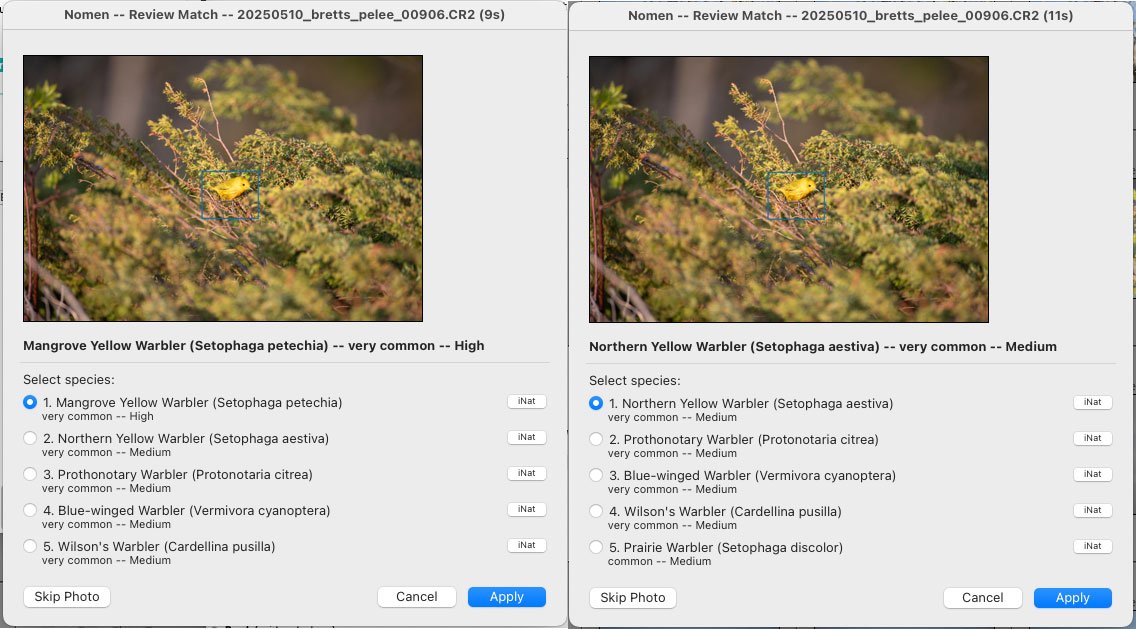
Same photo. Same software. Different data. Mangrove Warbler isn’t even a candidate in Canada anymore, because the regional checklist confirms it doesn’t occur there.
If you’re in the beta and you see a suggestion that’s regionally wrong, flag it in the portal. Most species-level errors I see track back to something like this: a split that left the data behind. That’s what the beta is for.